.svg)


.webp)
.webp)
.png)
.png)


.png)


.png)

.png)

.png)


Recent Posts



Categories
Tags
Table of content
SHARE THIS ARTICLE
Is this blog hitting the mark?
Contact Us
Table of Contents
- Key Takeaways:
- Before We Talk About Frameworks, Let’s Clear the Confusion
- How We Evaluated These JavaScript Frameworks?
- Top 5 JavaScript Test Automation Frameworks in 2026
- Types of Test Automation Frameworks Beyond JavaScript
- How to Choose the Right Framework Without Overthinking?
- Final Thoughts
- FAQs
A clear guide to frameworks, tools, and making the right automation choice
JavaScript continues to sit at the core of modern software development. From frontend-heavy web platforms to APIs and cloud-native systems, JavaScript powers how today’s applications are built, shipped, and scaled.
Naturally, JavaScript-based test automation has evolved alongside it. But by 2026, the challenge is no longer whether to automate. The real challenge is understanding what to automate with, and more importantly, how frameworks and tools actually fit together.
For many non-technical stakeholders, this is where confusion begins. Frameworks, tools, platforms, libraries; everything sounds interchangeable.
Well, they are not, and misunderstanding this distinction often leads to fragile automation, high maintenance costs, and slow releases. This blog is designed to remove that confusion before recommending anything.
Key Takeaways:
- Test automation frameworks and tools serve different purposes. Automation frameworks define test structure, scalability, and maintenance strategy, while tools execute tests within that framework.
- Modern JavaScript automation tools include built-in frameworks. Frameworks like Playwright, Cypress, WebdriverIO, TestCafe, and Nightwatch bundle execution, structure, and reporting under the same name
- Choosing the right test automation framework impacts long-term ROI. A well-designed framework reduces flakiness, maintenance cost, and release risk across CI/CD pipelines.
- JavaScript test automation frameworks are best for modern web applications. They align with SPA architectures, frontend-heavy systems, micro-frontends, and fast DevOps workflows.
- Different types of automation frameworks fit different testing needs. Keyword-driven, data-driven, BDD, hybrid, and language-specific frameworks address different application and team maturity levels.
- Framework maturity matters more than automation volume. Stable environments, structured test design, and ownership must exist before scaling automation or introducing AI.
- The best automation framework is the one that scales with your system. Successful teams select frameworks based on application architecture, team skills, and long-term maintainability, not trends.
Before We Talk About Frameworks, Let’s Clear the Confusion
What is a Test Automation Framework?
A test automation framework is the structure and system that defines how automated tests are written, organized, executed, and maintained over time.
A framework decides:
- How are test cases structured?
- How is test data handled?
- How are failures reported?
- How does automation scale as teams grow?
- How does testing integrate with CI/CD pipelines?
In simple terms, a framework is the foundation of your automation strategy, not just a way to run tests.
What Are Automation Tools?
Automation tools are execution enablers. They help run tests, manage environments, generate reports, and integrate with delivery pipelines.
Tools answer questions like:
- Where do tests run?
- How fast do they execute?
- How do results get visualized?
- How does automation plug into CI/CD?
Frameworks define how testing works. Tools help testing run.
Tools Often Come With Their Own Frameworks
In modern JavaScript automation, the line between tool and framework is not always obvious because many tools ship with their own built-in frameworks, often carrying the same name as the tool itself.
When teams say they use Playwright, Cypress, or WebdriverIO, they are usually referring to:
- The execution capability and
- The framework structure bundled with it
This is different from older testing approaches where tools and frameworks were separate choices.
However, this does not remove the need for framework thinking.
Even when a tool provides a ready-made framework, teams still must decide:
- How are tests structured across the application?
- How data and environments are managed?
- How does automation scale and stay maintainable?
- How failures are analyzed and acted upon?
The tool provides the starting point. The framework design determines long-term success.
How We Evaluated These JavaScript Frameworks?
The frameworks listed below are evaluated based on:
- Long-term stability and maintainability
- Fit for modern web architectures
- CI/CD and cloud execution readiness
- Developer and QA experience
- Scalability as teams and systems grow
This is not a popularity list.
It is an execution-focused guide.
Top 5 JavaScript Test Automation Frameworks in 2026
1) Playwright
Playwright has emerged as one of the most forward-looking JavaScript automation frameworks. It is designed to handle modern, highly dynamic web applications with strong cross-browser support and reliable execution.
It provides built-in capabilities for tracing, debugging, and handling asynchronous behavior, making it well-suited for modern frontend stacks. Teams using Playwright benefit from faster feedback and lower flakiness when frameworks are structured properly.
Playwright works best for teams that value speed and stability, but it still requires thoughtful framework organization to avoid test sprawl as coverage grows.
Key features:
- Cross-browser support from a single API
- Built-in test runner, assertions, and reporting
- Strong handling of async UI behavior
- Tracing and debugging out of the box
Best fit: Teams building modern web apps that need speed, stability, and reliable cross-browser testing.
2) Cypress
Cypress is known for its developer-friendly experience and fast onboarding. Its close integration with frontend workflows makes it particularly attractive to teams where developers actively contribute to test automation.
It excels at validating UI behavior and frontend logic, offering clear debugging and immediate feedback during execution. For many teams, this lowers the barrier to adopting automation.
However, Cypress works best when paired with a clear test strategy. Without structure, teams may encounter limitations as test suites scale across browsers and environments.
Key features:
- Real-time execution with visual debugging
- Strong integration with frontend workflows
- Built-in assertions and test runner
- Active ecosystem and plugins
Best fit: Teams where developers actively contribute to test automation and frontend validation.
Must Read: Playwright vs Cypress: choosing the right web automation tool
3) WebdriverIO
WebdriverIO is one of the most flexible JavaScript automation frameworks available. It supports browser, mobile, and API testing and integrates well with enterprise ecosystems.
This flexibility makes it ideal for complex systems that require deep customization and long-term scalability. Teams can build highly tailored automation architectures using WebdriverIO.
The trade-off is complexity. WebdriverIO performs best when owned by experienced teams with strong conventions and governance.
Key features:
- Supports web, mobile, and API testing
- Highly customizable architecture
- Integrates well with Selenium and cloud grids
- Strong CI/CD compatibility
Best fit: Large systems requiring customization, multi-platform testing, and long-term scalability.
4) TestCafe
TestCafe focuses on simplicity and consistent execution. It removes much of the setup complexity traditionally associated with browser automation and delivers stable results across environments.
It is well-suited for teams that want predictable regression testing without heavy configuration. TestCafe shines when applications are relatively stable and testing goals are clearly defined.
While it may not offer the deepest customization, its reliability makes it a strong choice for disciplined teams prioritizing consistency.
Key features:
- Minimal setup and configuration
- Stable execution across environments
- Built-in parallel execution
- No browser plugins required
Best fit: Teams seeking reliable regression automation without heavy framework complexity.
5) Nightwatch.js
Nightwatch.js represents the evolution of Selenium-based JavaScript automation into a more structured, modern framework. It provides strong configuration control and compatibility with existing Selenium ecosystems.
It is often chosen by teams modernizing legacy automation while retaining proven execution models. Nightwatch supports gradual transformation rather than full rewrites.
Its effectiveness depends heavily on framework discipline and experienced test architecture design.
Key features:
- Structured configuration and test organization
- Selenium and WebDriver compatibility
- Supports parallel execution
- Gradual modernization path for legacy automation
Best fit: Teams migrating from legacy Selenium setups while retaining JavaScript-based workflows.
Types of Test Automation Frameworks Beyond JavaScript
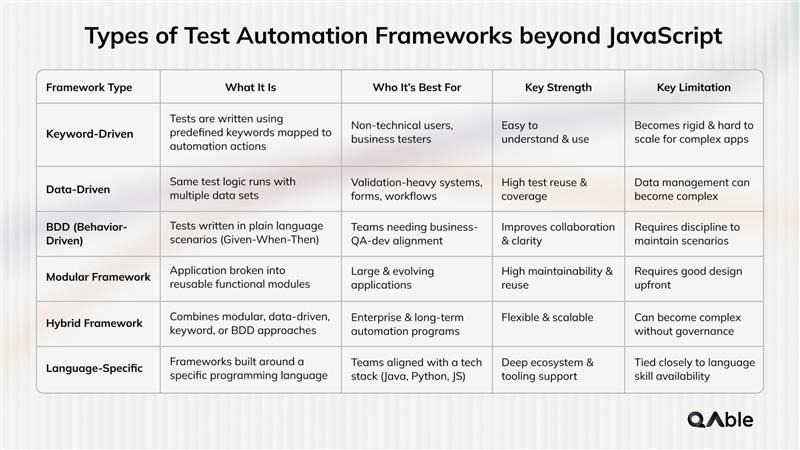
Before focusing on JavaScript, it’s important to understand that automation frameworks are language-agnostic in concept. JavaScript is one option, not the only one.
Here are the most common types of automation frameworks used across industries in 2026.
1) Keyword-Driven Automation Frameworks
Keyword-driven frameworks allow test cases to be written using predefined action words such as Click, Login, or Verify. These keywords are mapped to underlying automation logic.
They are useful for reducing coding effort and allowing non-technical team members to participate. However, they can become rigid and harder to scale for complex applications.
Key features:
- Easy for non-technical users to understand
- Test steps written in readable keywords
- Logic maintained separately from test cases
Best fit: Business-heavy applications with repetitive workflows and limited UI complexity.
2) Data-Driven Automation Frameworks
Data-driven frameworks separate test logic from test data. The same test case is executed multiple times with different data inputs.
These frameworks are effective for validating forms, workflows, and edge cases. They improve test coverage but still require disciplined structure to avoid data sprawl.
Key features:
- External test data (CSV, Excel, JSON, databases)
- High test reuse across scenarios
- Efficient validation of edge cases
Best fit: Forms, workflows, financial systems, and validation-heavy applications.
3) Behavior-Driven Development (BDD) Frameworks
BDD frameworks focus on describing system behavior using readable scenarios, typically in a “Given-When-Then” format.
They improve collaboration between business, QA, and development teams by aligning tests with business requirements. BDD works best when teams actively maintain scenarios as living documentation.
Key features:
- Human-readable scenarios (Given–When–Then)
- Strong collaboration between business, QA, and developers
- Living documentation through tests
Best fit: Products with strong business-rule validation and cross-team collaboration needs.
4) Modular / Hybrid Automation Frameworks
Modular frameworks break the application into reusable components or modules, each with its own test logic.
Hybrid frameworks combine multiple approaches such as data-driven, keyword-driven, and modular designs.
Key features:
- Modular test design
- Reusable components
- Scales across teams and applications
Best fit: Large products, enterprise systems, and long-term automation programs.
5) Language-Specific Automation Frameworks
Some frameworks are built around specific programming languages like Java, Python, or JavaScript.
These frameworks integrate deeply with development ecosystems and tooling. The best choice depends on the technology stack, team expertise, and integration requirements.
Key features:
- Deep ecosystem support tied to the chosen language
- Native tooling, libraries, and community resources
- Strong integration with development, build, and CI/CD pipelines
Best fit: Teams that want test automation tightly aligned with their primary development language and long-term engineering stack.
How to Choose the Right Framework Without Overthinking?
There is no universally “best” framework in 2026.
The right choice depends on:
- Your application architecture
- Your release velocity
- Your team’s automation maturity
- Your long-term maintenance goals
A simpler framework with strong discipline often outperforms a powerful one with poor structure.
Final Thoughts
In 2026, test automation success is not driven by tools alone. It is driven by how intentionally frameworks are designed and governed over time.
At QAble, we see this consistently as we operate as a quality intelligence lab embedded within engineering teams. Strong frameworks come first. Tools support execution. Intelligence and optimization follow when systems are ready.
When automation is built with clarity and discipline, it stops being a maintenance burden and starts becoming a competitive advantage.
The real question is no longer which framework is trending. It is which framework your system can grow with.
Must Read: Scalable QA process for fast delivery
Discover More About QA Services
sales@qable.ioDelve deeper into the world of quality assurance (QA) services tailored to your industry needs. Have questions? We're here to listen and provide expert insights


Viral Patel
Co-Founder
Follow


Viral Patel is the Co-founder of QAble, delivering advanced test automation solutions with a focus on quality and speed. He specializes in modern frameworks like Playwright, Selenium, and Appium, helping teams accelerate testing and ensure flawless application performance.







.webp)

