


A digital product that is not accessible is effectively unusable for millions of users.
As websites, applications, and digital services become essential for everyday activities, organizations are increasingly expected to ensure their platforms are accessible to people with disabilities.
Accessibility testing helps identify barriers that may prevent users from interacting with digital interfaces, particularly those who rely on assistive technologies such as screen readers, keyboard navigation, or magnification tools.
Most accessibility testing frameworks are built around the Web Content Accessibility Guidelines (WCAG), which define internationally recognized standards for making digital content accessible.
However, accessibility testing is not limited to automated scans. While tools can detect common issues such as missing alternative text or color contrast problems, many accessibility barriers involve interaction patterns and usability factors that require broader evaluation.
In this guide, we explore key best practices in accessibility testing that help development and QA teams identify accessibility barriers and build digital products that are usable for a wider range of users.
Key Takeaways
- Accessibility testing should be integrated early in the development lifecycle, not treated as a final validation step.
- Automated accessibility checkers help identify common issues, but they need to be combined with broader evaluation for complete accessibility coverage.
- Testing with assistive technologies such as screen readers and keyboard navigation is essential to understand real user interactions.
- Accessibility improves overall product usability, not just compliance, by enhancing navigation, readability, and interaction design.
- A significant global audience depends on accessible digital experiences, making accessibility both a usability and business consideration.
- Common mistakes such as relying only on automation or ignoring user workflows can lead to incomplete accessibility outcomes.
- Continuous accessibility testing and monitoring are necessary as digital products evolve over time.
- Combining structured testing practices with ongoing evaluation helps build more inclusive, compliant, and reliable digital platforms.
What Is Accessibility Testing?
Accessibility testing is the process of evaluating digital products to ensure they can be used by people with disabilities. This includes identifying barriers that may prevent users from accessing or interacting with websites, web applications, or mobile applications.
Accessibility testing focuses on users who may rely on assistive technologies or alternative interaction methods, such as:
- Screen readers
- Keyboard-only navigation
- Voice input tools
- Magnification software
The goal of accessibility testing is to ensure that digital interfaces are usable regardless of how users access them.
Most accessibility testing practices are guided by the Web Content Accessibility Guidelines (WCAG), which define standards for making digital content accessible. These guidelines are built around four core principles:
- Perceivable - Information must be presented in ways users can perceive
- Operable - Interfaces must be navigable using different input methods
- Understandable - Content and interactions must be easy to comprehend
- Robust - Content should work reliably with assistive technologies
By evaluating digital products against these principles, accessibility testing helps development and QA teams identify usability barriers and improve the overall accessibility of digital platforms.
Related Read: Accessibility testing complete guide
Why Accessibility Testing Matters?
Accessibility testing plays an important role in ensuring that digital products are usable by a wide range of users, including people with disabilities.
Factor | What It Means | Why It Matters |
|---|---|---|
Regulatory Compliance | Accessibility testing helps align digital platforms with standards such as WCAG and other regulatory frameworks. | Reduces legal risks, compliance audits, and potential penalties. |
Improved User Experience | Fixing accessibility issues often improves navigation, readability, and interface clarity. | Better usability benefits all users, not only those with disabilities. |
Broader User Reach | According to WHO, 1.3 billion people globally live with disabilities. | Accessible platforms can reach a significantly larger audience. |
Stronger Product Quality | Accessibility testing reveals structural issues in UI design, navigation, and interaction patterns. | Improves overall reliability and usability of digital platforms. |
As digital platforms become central to services such as banking, healthcare, education, and commerce, accessibility is increasingly treated as a core requirement in product development rather than an optional enhancement.
Several factors explain why accessibility testing has become an essential part of modern digital development.
1. Regulatory Compliance
Many countries and industries require digital platforms to follow accessibility standards such as the Web Content Accessibility Guidelines (WCAG).
Organizations that fail to meet accessibility requirements may face:
- Legal complaints or lawsuits
- Regulatory compliance audits
- Accessibility remediation requirements
Accessibility testing helps teams identify issues early and align their platforms with accessibility regulations and standards.
2. Improved User Experience
Accessibility issues often overlap with general usability problems. Fixing accessibility barriers can improve how users interact with digital interfaces overall.
Common usability improvements include:
- Clearer navigation structures
- Better color contrast for readability
- Consistent page hierarchy
- Improved form accessibility
Addressing these issues often leads to better user experience for all users.
3. Broader User Reach
Millions of people globally rely on assistive technologies or alternative interaction methods to access digital content.
Accessibility testing ensures digital platforms work with tools such as:
- Screen readers
- Keyboard navigation
- Voice commands
- Magnification tools
By supporting these interaction methods, organizations can make their digital services accessible to a wider audience.
4. Stronger Product Quality
Accessibility testing can also reveal structural issues in digital products that might otherwise go unnoticed.
Accessibility evaluations often highlight:
- Inconsistent interface structures
- Broken navigation flows
- Poorly labeled content elements
- Unclear interaction patterns
Fixing these issues improves the overall reliability and structure of digital interfaces.
Because of these factors, accessibility testing is increasingly integrated into modern development workflows alongside functional testing, performance testing, and security testing.
Related Read: Software quality and business risk
Best Practices in Accessibility Testing
Accessibility testing is most effective when it is integrated throughout the product development lifecycle rather than treated as a final compliance step. Following structured accessibility testing practices helps teams identify barriers early and improve digital usability across platforms.
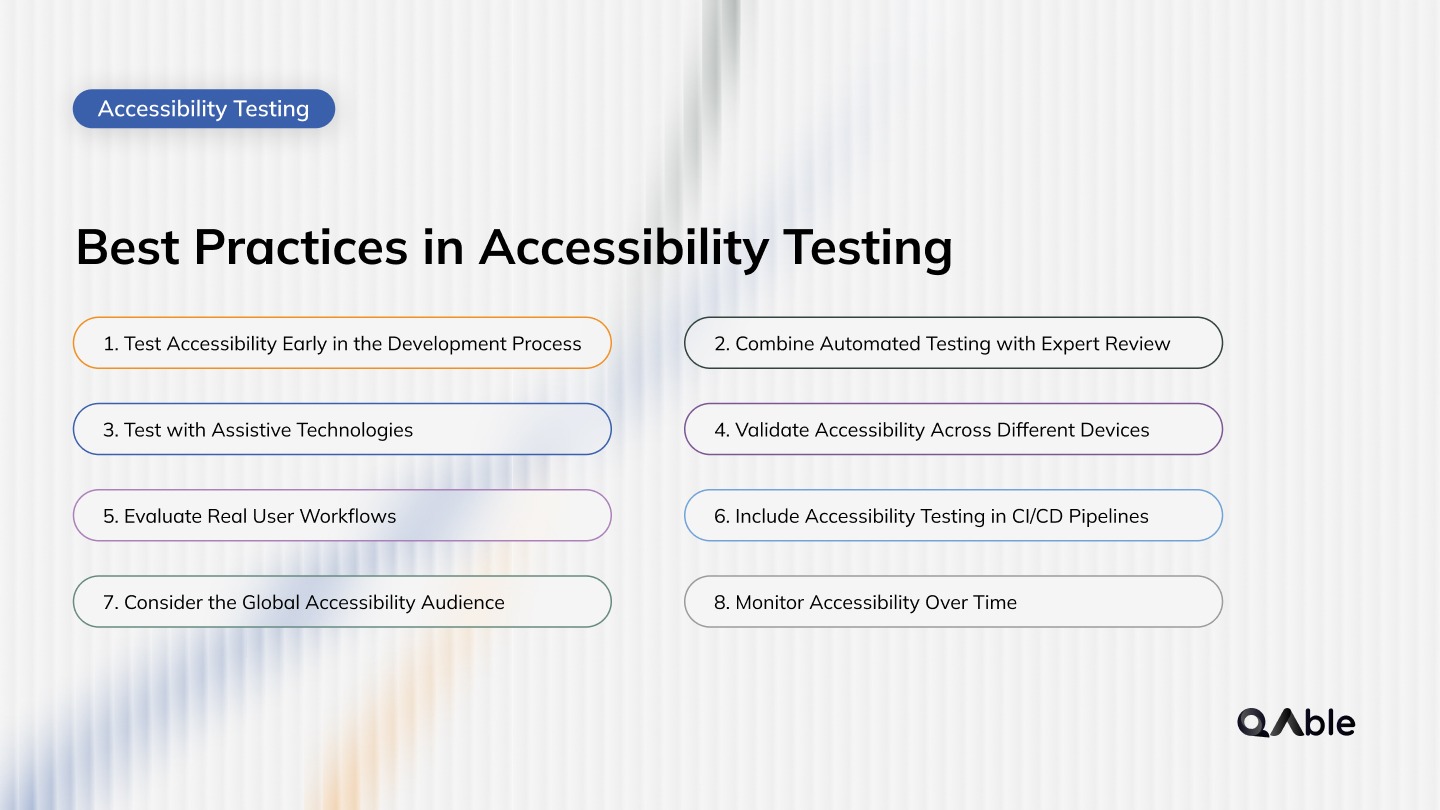
Below are several widely adopted best practices that help development and QA teams conduct accessibility testing more effectively.
1. Test Accessibility Early in the Development Process
Accessibility testing should begin during the early stages of product development. Waiting until the final testing phase often makes accessibility issues harder and more expensive to fix.
Accessibility checks can be introduced during:
- Design validation
- Development workflows
- Automated testing pipelines
- Pre-release quality assurance
When accessibility is evaluated early, teams can identify structural accessibility issues before they become deeply embedded in the product.
2. Combine Automated Testing with Expert Review
Automated accessibility tools help detect common accessibility violations quickly, but they cannot fully evaluate usability or interaction patterns.
Effective accessibility testing often includes:
- Automated accessibility scanning
- Assistive technology testing
- Keyboard navigation testing
- Workflow and interaction evaluation
Combining automation with expert evaluation helps teams identify both technical accessibility violations and usability-related accessibility barriers.
3. Test with Assistive Technologies
Accessibility testing should include validation using assistive technologies that many users rely on when interacting with digital products.
Common assistive technologies used during testing include:
- Screen readers such as JAWS, NVDA, or VoiceOver
- Keyboard-only navigation
- Voice control tools
- Magnification software
Testing with these tools helps teams understand how users with disabilities interact with digital interfaces and identify accessibility issues that automated tools may not detect.
4. Validate Accessibility Across Different Devices
Digital platforms often operate across multiple environments. Accessibility testing should ensure that accessibility standards are maintained across these different contexts.
Testing environments may include:
- Desktop browsers
- Mobile devices
- Web applications
- Responsive layouts
Ensuring accessibility across devices helps maintain consistent usability regardless of how users access the platform.
5. Evaluate Real User Workflows
Accessibility testing should not focus only on individual components. It should also evaluate how users navigate through complete workflows within the product.
Examples of workflows to evaluate include:
- User registration and login
- Form submission processes
- Navigation across application pages
- Transaction or checkout flows
Testing full workflows helps identify accessibility barriers that may appear during real user interactions.
6. Include Accessibility Testing in CI/CD Pipelines
Integrating accessibility testing into continuous integration and deployment workflows allows teams to detect accessibility issues automatically as new code is introduced.
Accessibility checks can run during:
- Code commits
- Build processes
- Automated test execution
- Deployment pipelines
This approach helps teams maintain accessibility standards consistently across releases.
7. Consider the Global Accessibility Audience
Accessibility testing should also account for the scale of users who rely on accessible digital experiences.
According to the World Health Organization (WHO), an estimated 1.3 billion people; about 16% of the global population live with some form of significant disability, meaning roughly 1 in every 6 people worldwide may face barriers when interacting with inaccessible digital platforms.
Accessibility challenges remain widespread across the web as well. According to the WebAIM Million Report, 94.8% of the top one million websites still contain detectable WCAG accessibility failures, highlighting how common accessibility barriers remain across modern digital platforms.
Accessibility also has economic implications. Research referenced by the World Economic Forum estimates that people with disabilities and their families represent more than $13 trillion in annual global spending power.
Considering the scale of users affected by accessibility barriers reinforces why accessibility testing should be treated as a core part of digital product quality rather than a secondary compliance activity.
8. Monitor Accessibility Over Time
Accessibility is not a one-time activity. As digital platforms evolve, new accessibility issues may appear.
Organizations should periodically review accessibility across their platforms through:
- Regular accessibility audits
- Automated accessibility scans
- Accessibility regression testing
Continuous monitoring helps ensure accessibility remains consistent as products evolve and new features are introduced.
Accessibility testing is most effective when it becomes a continuous part of product development rather than a final validation step. Combining automation, assistive technology testing, and structured evaluation helps teams identify accessibility barriers earlier and improve overall digital usability.
Following these best practices allows organizations to build digital platforms that are more inclusive, compliant, and reliable for a broader range of users.
Related Read: Manual testing to test automation
Common Accessibility Testing Mistakes to Avoid
While many teams recognize the importance of accessibility testing, it is often implemented incorrectly or too late in the development process. These mistakes can lead to accessibility barriers remaining unresolved even when testing tools are used.
Mistake | Description | Impact |
|---|---|---|
Treating Accessibility as a Final Testing Step | Accessibility testing is performed only at the end of development rather than during design and development stages. | Issues become harder and more expensive to fix and may delay releases. |
Relying Only on Automated Testing Tools | Teams depend entirely on automated scans to detect accessibility issues. | Many usability and assistive technology problems remain undetected. |
Ignoring Real User Interaction Flows | Testing focuses on individual UI elements instead of complete user journeys. | Accessibility barriers appear during tasks like registration, forms, or checkout flows. |
Overlooking Assistive Technology Compatibility | Platforms are not tested using screen readers, keyboard navigation, or other assistive tools. | Interfaces may pass automated checks but remain unusable for many users. |
Failing to Monitor Accessibility Over Time | Accessibility testing is treated as a one-time activity instead of ongoing validation. | New features and updates may introduce accessibility issues later. |
Understanding common accessibility testing mistakes helps teams build more effective testing strategies and improve accessibility outcomes.
1. Treating Accessibility as a Final Testing Step
Accessibility testing is sometimes performed only at the end of the development cycle. When testing happens this late, accessibility issues may already be deeply integrated into the interface design and code structure.
This approach often results in:
- Expensive remediation efforts
- Delayed product releases
- Incomplete accessibility fixes
Accessibility testing should instead be integrated throughout the product lifecycle, beginning during design and continuing through development and testing phases.
2. Relying Only on Automated Testing Tools
Automated accessibility tools are useful for identifying many common accessibility violations, but they cannot detect every accessibility barrier.
Automated tools typically detect issues such as:
- Missing alternative text
- Color contrast failures
- Improper markup structure
However, they cannot fully evaluate usability, reading order, interaction flows, or assistive technology behavior. A more comprehensive accessibility strategy includes automated tools alongside broader evaluation methods.
3. Ignoring Real User Interaction Flows
Accessibility testing sometimes focuses only on individual page elements rather than complete user journeys. This can cause accessibility barriers to remain hidden within complex workflows.
Common workflows that should be tested include:
- User onboarding processes
- Multi-step forms
- Checkout or transaction flows
- Account management features
Testing full workflows helps ensure that accessibility is maintained throughout the entire user experience.
Related Read: User experience testing
4. Overlooking Assistive Technology Compatibility
Digital platforms may technically pass automated accessibility scans but still fail when used with assistive technologies.
Accessibility testing should include evaluation with tools such as:
- Screen readers
- Keyboard navigation
- Voice control tools
- Magnification software
Testing with assistive technologies helps teams identify accessibility barriers that automated tools cannot detect.
5. Failing to Monitor Accessibility Over Time
Accessibility testing is sometimes treated as a one-time activity performed during a single audit or product release. However, as digital platforms evolve, new accessibility issues may appear.
Organizations should maintain accessibility through:
- Periodic accessibility audits
- Accessibility regression testing
- Continuous monitoring of digital platforms
Regular evaluation helps ensure accessibility remains consistent as new features and updates are introduced.
Avoiding these common accessibility testing mistakes helps teams build more reliable accessibility strategies. By combining structured testing practices with continuous monitoring, organizations can improve accessibility while reducing the risk of compliance issues and usability barriers.
Accessibility Checker vs Web Accessibility Consultant
Accessibility checkers have become an important part of modern accessibility testing workflows. Many development and QA teams use automated accessibility checkers to quickly scan digital platforms and identify common accessibility issues.
These tools typically evaluate digital interfaces against rules derived from accessibility standards such as the Web Content Accessibility Guidelines (WCAG) and highlight issues in areas such as page structure, markup, and visual elements.
Accessibility checkers are commonly used for:
- Automated accessibility scans
- Continuous accessibility monitoring
- Integration with development pipelines
- Early detection of technical accessibility violations
While these tools provide valuable insights, accessibility evaluation often requires deeper analysis than automated rules alone can provide.
Web accessibility consultants help organizations interpret accessibility findings, validate user interactions, and ensure that digital platforms work effectively with assistive technologies.
Modern web accessibility consulting does not rely only on manual testing. Instead, consultants typically combine automated accessibility checkers, AI-assisted analysis, and expert review to evaluate digital products more comprehensively.
This may include testing with technologies such as:
- Screen readers (JAWS, NVDA, VoiceOver)
- Keyboard-only navigation
- Voice interaction tools
- Other assistive technologies used by real users
Why Does this Matter for Compliance?
Accessibility is increasingly becoming part of regulatory expectations for digital platforms.
SEBI introduced regulatory updates on 31 July 2025 requiring digital accessibility compliance for regulated financial entities.
These requirements apply to organizations such as:
- Stock exchanges
- Depositories and clearing corporations
- Brokers and mutual funds
- Investment advisers and portfolio managers
- Other financial intermediaries
Accessibility compliance extends beyond websites and may include:
- Mobile applications
- Investor portals and dashboards
- Digital KYC workflows such as e-KYC and video KYC
- Digital documents such as reports and PDFs
Organizations are expected to align these systems with accessibility standards such as:
- WCAG 2.1 (or the latest version)
- GIGW guidelines
- IS 17802 accessibility standards
- Rights of Persons with Disabilities (RPwD) Act
Because accessibility compliance often requires structured audits and usability validation, many organizations adopt a hybrid accessibility testing approach that combines automated accessibility checkers with expert accessibility evaluation.
Accessibility checkers help identify many technical accessibility issues quickly, while web accessibility consultants help evaluate deeper usability and assistive technology interactions.
Combining automation with structured accessibility evaluation allows organizations to build more reliable accessibility testing strategies while aligning with evolving accessibility standards and regulatory expectations.
Related Read: QAOps best practices
Final Thoughts
Accessibility testing has become an essential part of modern digital development. As digital platforms continue to expand across industries, ensuring that websites and applications are usable for all users is increasingly important.
Following structured accessibility testing practices helps organizations identify usability barriers early and improve the overall quality of digital experiences. Integrating accessibility testing into development workflows, validating interfaces with assistive technologies, and continuously monitoring accessibility can significantly reduce accessibility risks.
Accessibility checkers provide a fast way to identify technical accessibility issues, while web accessibility consultants help evaluate deeper usability and assistive technology interactions. Together, these approaches help organizations build more reliable accessibility testing strategies.
At QAble, our accessibility testing services combine automated accessibility evaluation, structured testing workflows, and assistive technology validation to help organizations identify accessibility barriers and align their digital platforms with global accessibility standards.
Building accessible digital products is not only about compliance, it is about creating digital experiences that are usable, inclusive, and reliable for a broader range of users.
Related Read: Scalable QA process for fast delivery